Child Exploitation (including Child Sexual Exploitation and Criminal Exploitation)
Scope of this chapter
This chapter provides guidance for responding to the challenges of protecting children exposed to exploitation. Children made vulnerable to exploitation requires a response which takes a holistic view to safeguarding and ‘The Multi Agency Child Exploitation’ (MACE) framework is accessible via the ISCP website. The MACE Framework guidance considers exploitation as a broader concept encompassing, but not limited to, sexual and criminal exploitation both of which interconnect with risks and vulnerabilities such as missing, child trafficking, county lines, modern slavery, gangs, harmful sexual behaviour and youth violence and anti- social behaviour. These risks must be considered within a contextual safeguarding framework to effectively understand, and respond to, young people’s experiences of significant harm beyond their families.
The world of Safeguarding is ever changing; it is becoming increasingly complex and child exploitation should not be seen in isolation as it often overlaps with child-on-child violence and abuse, modern day slavery, harmful sexual behaviour, gang and group activity, anti-social and offending behaviour and going missing from home or care. Together these create a set of harmful circumstances and experiences for children and young people.
Exploitation affects all children from all backgrounds and it can have a serious impact on every aspect of the lives of children involved and on their families. Due to its nature, child exploitation is a crime that has no borders. Cross border agency cooperation is therefore crucial.
The principles of the Bailiwick of Guernsey Safeguarding Together reflects changes to traditional child safeguarding practice and the increasing knowledge and understanding relating to extra familial risks to children and young people. Children may be at risk of or experiencing physical, sexual, or emotional abuse and exploitation in contexts outside their families.
Extra-familial contexts include a range of environments outside the family home in which harm can occur. These can include peer groups, school, and community/public spaces, including known places in the community where there are concerns about risks to children as well as online, including social media or gaming platforms.
Whilst there is no legal definition for the term extra-familial harm, it is widely used to describe different forms of harm that occur outside the home. Children can be vulnerable to multiple forms of extra-familial harm from both adults and/or other children. Examples of extra-familial harm may include (but are not limited to): criminal exploitation (such as county lines and financial exploitation), serious violence, modern slavery and trafficking, online harm, sexual exploitation, child-on-child (nonfamilial) sexual abuse and other forms of harmful sexual behaviour displayed by children towards their peers, abuse, and/or coercive control, children may experience in their own intimate relationships (sometimes called teenage relationship abuse), and the influences of extremism which could lead to radicalisation.
Child sexual exploitation is a form of child sexual abuse. It occurs where an individual (CSE perpetrator) takes advantage of an imbalance of power to coerce, manipulate or deceive a child or young person under the age of 18 into sexual activity (a) in exchange for something the victim needs or wants, and/or (b) for the financial advantage or increased status of the perpetrator or facilitator. The victim may have been sexually exploited even if the sexual activity appears consensual. Child sexual exploitation does not always involve physical contact; it can also occur through the use of technology.
Child criminal exploitation involves exploitative situations, contexts, and relationships where children (under 18) receive or are promised ‘something’ tangible, for example, food, accommodation, drugs, alcohol, cigarettes, gifts or money or ‘something’ intangible, for example, affection, respect, status, or protection in return for committing a criminal act for the benefit of another individual or group of individuals or be threatened, coerced, or intimidated into committing that criminal act.
County lines is a form of criminal exploitation and is a term used to describe gangs and organised criminal networks involved in exporting illegal drugs into one or more importing areas using dedicated mobile phone lines or other form of “deal line”. They are likely to exploit children and vulnerable adults to move and store the drugs and money and they will often use coercion, intimidation, violence (including sexual violence) and weapons. It should be recognised that some victims of County Lines pose risks to their peers as it is not unusual for those already groomed and recruited to be pressured and/or rewarded to recruit others.
Children who are exploited are victims of abuse and their needs should be carefully assessed. The aim of any intervention should be to protect them from further harm.
The Bailiwick of Guernsey Multi Agency Child Exploitation Framework Guidance requires agencies to work together to:
- Develop local prevention strategies;
- Identify children and young people at risk of exploitation;
- Take action to safeguard and promote the welfare of children and young people who are vulnerable to, or experiencing exploitation; and
- Take action against the facilitators and/or perpetrators of child exploitation.
In doing so, the key principles should be:
- A child-centred approach. Action should be focussed on the child’s individual needs; taking into consideration the fact that children do not always acknowledge what may be an exploitative or abusive situation;
- A proactive approach focussed on prevention, early identification and intervention as well as disrupting activity and prosecuting those who facilitate and/or perpetrate child exploitation;
- Parenting, family life, and services. Taking account of family circumstances when considering how best to safeguard and promote the welfare of children and young people;
- The rights of children and young people. Children and young people are entitled to be safeguarded from exploitation, just as agencies have duties in respect of safeguarding them and promoting their welfare;
- Responsibility for criminal acts. The exploitation of children and young people is child abuse. Police investigations should focus on those who facilitate and/or perpetrate the exploitation of children and young people.
- An integrated approach. Child exploitation requires a three-pronged multi-agency approach: prevention, protection and prosecution;
- A shared responsibility. There is a need for effective joint working between different agencies and practitioners underpinned by a strong commitment from senior leaders and managers across the partnership to effectively tackle child exploitation. A shared understanding of the problem of child exploitation and effective coordination should occur.
Any child or young person may be at risk of sexual or criminal exploitation, regardless of their family background or other circumstances.
Child exploitation results in children and young people suffering harm, and causes significant damage to their emotional, mental and physical health, affecting their overall wellbeing. It can also have profound and damaging consequences for the child's family. Parents and carers are often traumatised and under severe stress. Siblings can feel alienated and scared. The family network and the child’s peers and friends may suffer serious threats of abuse, intimidation and assault at the hands of facilitators and/or perpetrators of child exploitation.
There are strong links between children who experience exploitation and other behaviours such as running away from home or care, bullying, emotional wellbeing and mental health problems, drug and/or alcohol misuse, anti-social and offending behaviours, exclusion from school, and problems with family relationships. In addition, some children are particularly vulnerable to exploitation, for example, children with additional needs, children who are in care, care leavers, migrant children, unaccompanied asylum seeking children, and children who have experienced domestic abuse.
Children and young people are often groomed and exploited by children with whom they feel they have a relationship with. Due to the nature of grooming methods used by facilitators and those who exploit and abuse children and young people, it is very common for children and young people who are exploited not to recognise that they are being abused. Practitioners should be aware that older children in particular may believe themselves to be acting voluntarily, and they will need practitioners to work alongside them, to help them recognise that they are experiencing or have experienced exploitation and abuse.
Child exploitation is a form of child abuse. It can take many forms from a seemingly ‘consensual’ relationship where there is an exchange of something, such as attention, goods, status, a sense of belonging, substances, accommodation or gifts, to serious organised crime which involves international and/or internal child trafficking and modern slavery.
An imbalance of power within the relationship characterises child exploitation. Those who facilitate or perpetrate child exploitation always have a degree of power and control over the child or young person, and this often results in the child or young person having an increasing level of dependence on the person or persons exploiting them as the exploitative relationship develops. Coercion and violence go hand in hand with child exploitation.
Technology can play a part in child exploitation, for example, through its use to record and share incriminating activity and/or abuse, or as a medium to groom children and young people, and/or by utilising apps such as those that allow geo tracking, or online banking apps used for money laundering, or those which provide access to temporary accommodation.
Child exploitation also has strong links with other forms of crime, for example, online and offline grooming, the distribution of abusive images of children, modern day slavery, forced labour and child trafficking.
The perpetrators of child exploitation are often well organised and may use sophisticated tactics. They are known to target children and young people in online or offline places and spaces where children and young people come together with little or no adult supervision, such as music video channels, chat rooms and locations within the community.
Work to tackle child exploitation follows the same principles as addressing other forms of abuse or neglect.
Islands Safeguarding Children Partnership has ensured their policies and procedures cover:
- How to identify signs of child exploitation;
- How practitioners can seek help and advice;
- How practitioners should share information;
- The establishment of a Contextual Safeguarding Co-ordinator;
- Pathways for referring child exploitation concerns with Children’s Social Care Services and the Police;
- How practitioners can work together to deliver disruption plans;
- The process and possible responses for supporting children, young people their families.
- How to work with other local authority areas across geographical borders, to ensure that children and young people who are, or have been exploited, and their families, are safeguarded, and those who facilitate or exploit them are identified, targeted and disrupted;
- How to deal with issues relating to migrant children in situations which make them vulnerable to child exploitation;
- How to manage and respond to the facilitation of child exploitation through the use of technology.
Islands Safeguarding Children Partnership has oversight of the Bailiwick of Guernsey Multi Agency Child Exploitation Framework to ensure the developments and practices are co-ordinated across agencies. The strategic oversight of child exploitation highlights the multi-agency commitment to safeguard and promote the welfare of children by ensuring that:
- Safeguarding training includes an awareness of child exploitation, and that this covers how to identify warning signs, how to make appropriate referrals for support and intervention, and how to capture and share information appropriately;
- Effective information sharing protocols are in place, ensuring that relevant information is always shared.
Prevention measures include:
- Reducing the vulnerability of children and young people;
- Improving children’s resilience;
- Disrupting and preventing the activities of facilitators and perpetrators;
- Reducing tolerance of exploitative behaviour;
- Building the strength of families and the local community to keep children safe;
- Prosecuting those who facilitate, exploit and abuse.
The development of education and awareness raising is vital to enable children and young people to make informed choices and safe decisions about friendships, behaviours, locations and relationships.
Resources for parents and carers (particularly those responsible for children living away from home) should help them understand how they can protect, build resilience and access support and this includes resources for places of employment to support in identification and to report concerns.
Any child can become a victim of exploitation. However, the majority of victims have a range of risk factors that make them particularly vulnerable.
These include:
- Having had previous contact with the youth justice system;
- Being a child in need or care-experienced;
- Poor mental health;
- Additional Learning Needs and Disabilities, particularly Attention Deficit Hyperactivity Disorder and Autism Spectrum Disorder;
- Alcohol or substance misuse issues;
- A history of adverse childhood experiences;
- Living in poverty or homelessness;
- Exclusion from mainstream education;
- Unsettled immigration status;
- Perceived sense of status, belonging and/or protection.
Anyone who comes into regular contact with a child is in a good position to notice changes in behaviour and/or physical signs, which may be an indication that the child or young person is experiencing exploitation and harm.
The fact that a young person is 16 or 17 years old should not alter how a practitioner/agency responds to a concern which relates to child exploitation.
Below are indicators linked to child exploitation, they include factors that may heighten vulnerability. The indicators do not create an exhaustive list, and each is not in itself proof that a child is at risk of exploitation, or is being exploited. Concern should increase with the number of indicators present, although one single indicator alone may in itself be significant. Practitioners should use their judgment and knowledge of a child/young person and their circumstances when assessing risk and vulnerability.
- Family and social relationships – hostility/aggression in relationship with parents, carers and/or other family members, or peers; association with adults or other children/young people who are assessed to be at risk of exploitation / known to be exploited; unexplained relationships with unknown adults, reduced contact with family/friends which is of concern, spends time at addresses and places not known to parent/carer, goes or is taken to places they have no known connections with. Gang association. New friendship groups;
- Health – evidence of drug, alcohol or substance misuse; self-harm, eating disorders; physical injuries, such as bruising, knife inflicted and/or sexual violence injuries. Low self-esteem; expressions around invincibility or not caring about what happens to them, low mood;
- Education – disengagement with education, employment or training; considerable change in performance and/or behaviour; not in mainstream education, excluded, whereabouts unknown during school/college/work hours;
- Behavioural – bullying/threatening behaviour, aggression, anti-social behaviour; offending behaviour; secretive, mood swings, social isolation, detachment from age appropriate activities/friendship groups;
- Social presentation – change in appearance/clothing, new tattoos, branding;
- Family and environmental factors – family history of parental neglect or abuse, mental health, domestic abuse, gang association/neighbourhood, offending, bereavement, parental separation, poverty and deprivation. Scared of reprisal or violence;
- Income – possession of unexplained money and/or items such as clothing, mobile phones, credit on mobile phones; sim cards; accounts of social activities including parties, and travel with no plausible explanation of the source of funding;
- Missing - from home, care or school which is a key indicator of child exploitation. Missing is defined when a child or you person is not where they are meant/thought to be and their whereabouts cannot be established. Reporting a child as missing is a crucial safeguarding tool
When considering child exploitation indicators, practitioners should take into account that these do not necessarily mean that a child is at risk of or experiencing exploitation.
It is crucial to recognise that a child with vulnerability factors does not automatically indicate that they are at risk of exploitation. The exploitation of a child occurs because a facilitator or abuser recognises, responds and takes advantage of a child’s vulnerability, and that this is often enabled by an absence of protective structures around the child, their family, social relationships and/or social spaces.
Every Child Exploitation Screening Indicator Tool and Child Exploitation Risk Outside the Home Assessment undertaken in relation to child exploitation should reflect the individual circumstances and characteristics of the child within their family, peer and community context. They should include an analysis of parental capacity to meet the needs and reduce the vulnerability of the child or young person, whether they arise from issues within the family or from the child or young person’s wider social relationships and/or community context.
Concerns that a child may be at risk of being exploited should be discussed with a manager and/or the designated professional for safeguarding and a decision made as to whether a referral to Children’s Social Care, is required to support with the identification and response to concerns around risk of harm occurring outside of the home environment.
Where appropriate, the wishes and feelings of the child or young person and their parents or carers should be obtained when deciding how to proceed. Practitioners should be aware that in some cases this may not be in the child’s best interests and could lead to the child being placed at further risk. Practitioners should seek advice from Children’s Social Care if they have any concerns about sharing information with a child, young person and/or their family, or about consulting parents or carers before making a referral to Children’s Social Care.
Where a practitioner or agency is concerned about losing the engagement of a child or young person by reporting their concern to Children’s Social Care, this should be discussed with Children’s Social Care to agree a way forward. Any decision not to share information or refer a child, should be fully recorded by the agency.
Practitioners should be aware that many children and young people who are sexually exploited do not see themselves as victims. In such situations, discussions with them about concerns should be handled with great sensitivity. Seeking prior advice from the Contextual Safeguarding Co-ordinator based in the MASH is useful.
In assessing whether a child or young person is a victim of sexual exploitation, or at risk, careful consideration should be given to the issue of consent. It is important to bear in mind that:
A significant number of children and young people who are being exploited may go missing from home or care, and education. Some go missing frequently; the more often they go missing the more vulnerable they are to being exploited. If a child does go missing, the Children Missing from Care, Home and Education should be followed.
Return to Home Interviews should always be completed with the child or young person. It can help in establishing why they went missing and the subsequent support that may be required, as well as preventing repeat incidents and preserving evidence. Information and intelligence gathered from return interviews can be used to inform the identification for Referral and Assessment of any child exploitation cases.
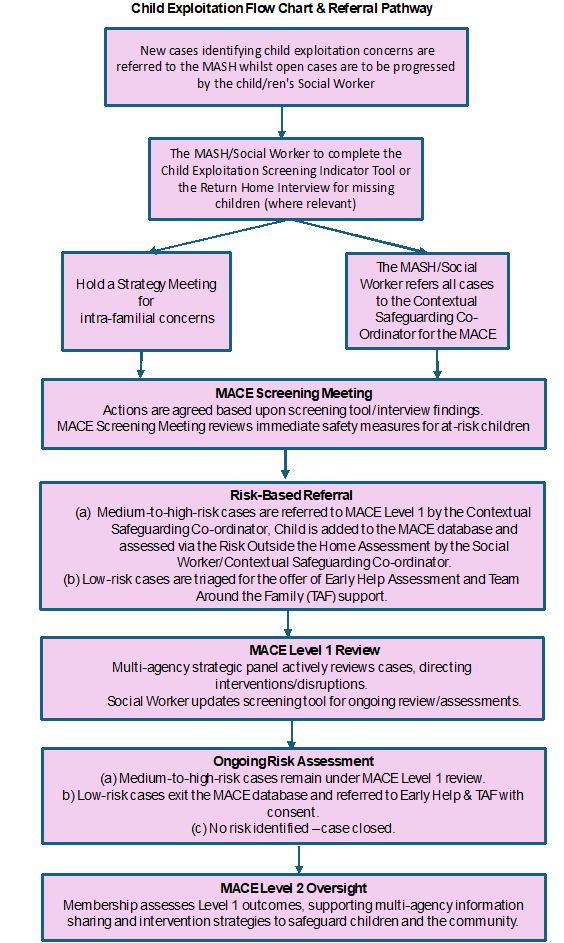
Where the concerns about the safety and wellbeing of the child or young person are such that a referral to the MASH for new cases and to the child’s social worker for allocated cases should be made and clearly stipulated that there are concerns in respect of child exploitation. The Contextual Safeguarding Co-ordinator based in the MASH must be notified of all cases of concern.
If concerns about child exploitation remain and there are concerns about the protective ability of the family a Strategy Meeting will be required.
Where immediate action to safeguard a child is required, it may involve removing the child from the home of a person who is exploiting them to a safe place. However, those working with children in these circumstances must never underestimate the power of perpetrators to find where the child is.
Such children will need placements with carers who have experience of building trusting relationships and skills at containing young people.
Children in Care can be more vulnerable to exploitation. Substitute carers must be able to recognise the possible indicators of both child sexual exploitation and criminal exploitation. Children in Care are subject to the same child protection procedures as those who live with their own families. However, their needs may be different and for this reason, their Independent Reviewing Officer must be kept informed of any concerns relating to child exploitation or any other form of suspected abuse. The child / young person's Care or Pathway Plan must include a strategy to keep them safe and it must be updated and reviewed regularly.
The flow chart below provides guidance on the referral pathway for children considered at risk of harm occurring outside of the home environment.
Working with sexually exploited children is a complex issue which can involve serious crime and investigations over a wide geographical area.
Children may be frightened of the consequences of disclosure and may need to be given time to discuss their experiences.
The need to share information discreetly in a timely fashion has been shown to be vital in these cases.
Agencies and practitioners involved with a child or young person experiencing child exploitation must consider disruption strategies which support the child or young person to leave the situation they find themselves in.
The prosecution and disruption of perpetrators is an essential part of the process in reducing harm. It is the responsibility of the police to gather evidence, investigate and interview perpetrators and prepare case files for consideration by the Guernsey Police and Law Officers of the Crown. with the intention of obtaining the successful conviction of offenders.
Practitioners from statutory agencies and voluntary sector organisations together with the child or young person, foster carers, and his / her family as appropriate, should agree on the services, which should be provided to them and how they will be coordinated. The types of intervention offered should be appropriate to their needs and should take full account of identified risk factors and their individual circumstances. This may include, for example, previous abuse, missing incidents, involvement in gangs and groups and/or child trafficking. Health services provided may include sexual health services and mental health services. Advice should be sought from the Contextual Safeguarding Co-ordinator based in the MASH.
For children who are in care issues raised and actions planned should be incorporated into the child's Care or Pathway Plan which will be reviewed as part of the child's child in care review and care team meetings.
Because the effects of child exploitation can last well into adulthood, support may be required over a long period of time.
The police and Law Officers of the Crown lead on the identification and prosecution of perpetrators. All practitioners, however, have a role in gathering, recording and sharing information with the police and other agencies, as appropriate and in agreement with them.
Practitioners and foster carers should bear in mind that exploitation often does not occur in isolation and has links to other crime types, including:
- Modern slavery and human trafficking;
- Domestic Abuse;
- Sexual violence in intimate relationships;
- Grooming (both online and offline);
- Abusive images of children and their distribution (organised abuse);
- Organised sexual abuse of children;
- Drugs-related offences (possession, supply and cultivation;
- Gang-related activity;
- Immigration-related offences.
Where alleged perpetrators are arrested and charged with offences against children or young people, allocated practitioners and foster carers should ensure they are supported throughout the prosecution process and beyond. Specialist agencies should be involved in supporting the child or young person, as required, for example, Willow House, The Bailiwick Sexual Assault Referral Centre, Bailiwick of Guernsey Victim Support and Witness Service and the Reparative Care Team who provide child sexual abuse therapy services.
Children's needs should remain paramount at all times and further information can be found below.
Child Exploitation: Definition and Guide for Practitioners (DfE, February 2017) - definition and a guide for practitioners, local leaders and decision makers working to protect children from child exploitation.
Contextual Safeguarding Network - This website provides an overview of the Contextual Safeguarding Research Programme, including its history, vision and mission, team, current suite of projects, and key publications
Counting Lives - Responding to Children who are Criminally Exploited (The Children’s Society, 2019)
Home Office Child Exploitation Disruption Toolkit, 2019 – disruption tactics for those working to safeguard children and young people under the age of 18 from sexual and criminal exploitation
Tackling Child Exploitation: A Resource Pack for Councils - includes case studies
Centre of Expertise on Child Sexual Abuse – aims to provide succinct relevant information from frontline practitioners and commissioners and brings together the most up to date research into an accessible overview, supporting confident provision of the best possible responses to child sexual abuse.
Barnardos - Child Exploitation
The role of protective parenting assessments and interventions in the prevention of child sexual abuse - Information from the Lucy Faithfull Foundation on how parents and carers can protect their children from sexual harm.
Tackling child exploitation and extra-familial harm - new Practice Principles to support professionals.
Last Updated: September 17, 2025
v20


You can translate the content of this page by selecting a language in the select box.
Copyright © tri.x